
Investigation: The Cost of Cheap
Kirri-Mae Sampson spends her days designing knitwear made to last, but she says much of the clothing arriving in wardrobes now is made to be bought quickly, worn briefly and thrown away.
As co-founder and co-director of Hatch+Make, an Australian knitwear studio focused on small-scale production and keeping garments in use for longer, Sampson sees ultra-fast fashion as a system designed for quick purchase and quicker disposal.
“There’s no real re-sale market for garments that are barely even valued by customers in the primary market,” she says.
“Which just means a faster route to landfill.”
Across Australia, unwanted clothing has become one of the fastest-moving household waste streams, with charities, councils and recyclers left managing the consequences.
Australian shoppers send hundreds of thousands of tonnes of clothing to landfill each year. In 2023 alone, Australians bought 1.42 billion new clothing items, while 222,000 tonnes ended up in landfill, according to Seamless Australia. The Australia Institute placed the figure even higher, estimating more than 300,000 tonnes of clothing is either landfilled or exported annually.
What was once occasional shopping has become frequent, low-cost consumption. Ultra-fast fashion platforms such as Temu and SHEIN have accelerated that shift, driven by social media microtrends, algorithm-led advertising and the pressure of rising living costs. In the year to June 2025, data shows 4.7 million Australians shopped on Temu and 2.6 million shopped on Shein, with repeat purchasing particularly strong across both platforms.
Gary Mortimer, Professor of Consumer Behaviour and Retail Marketing at Queensland University of Technology, says the appeal of Shein and Temu sits at the intersection of trend culture and financial pressure.
“Shein and Temu tend to be very focused on a young demography or consumer, and often consumers who are very focused on the latest styles and fashion, but they’re also financially constrained,” Mortimer says. “What they’re looking for are the latest styles, colours and sizes, but at really low prices.”
He says the sites also reduce the perceived risk of buying online, particularly when prices are so low that a poor purchase can feel disposable rather than worth returning, repairing or reselling.
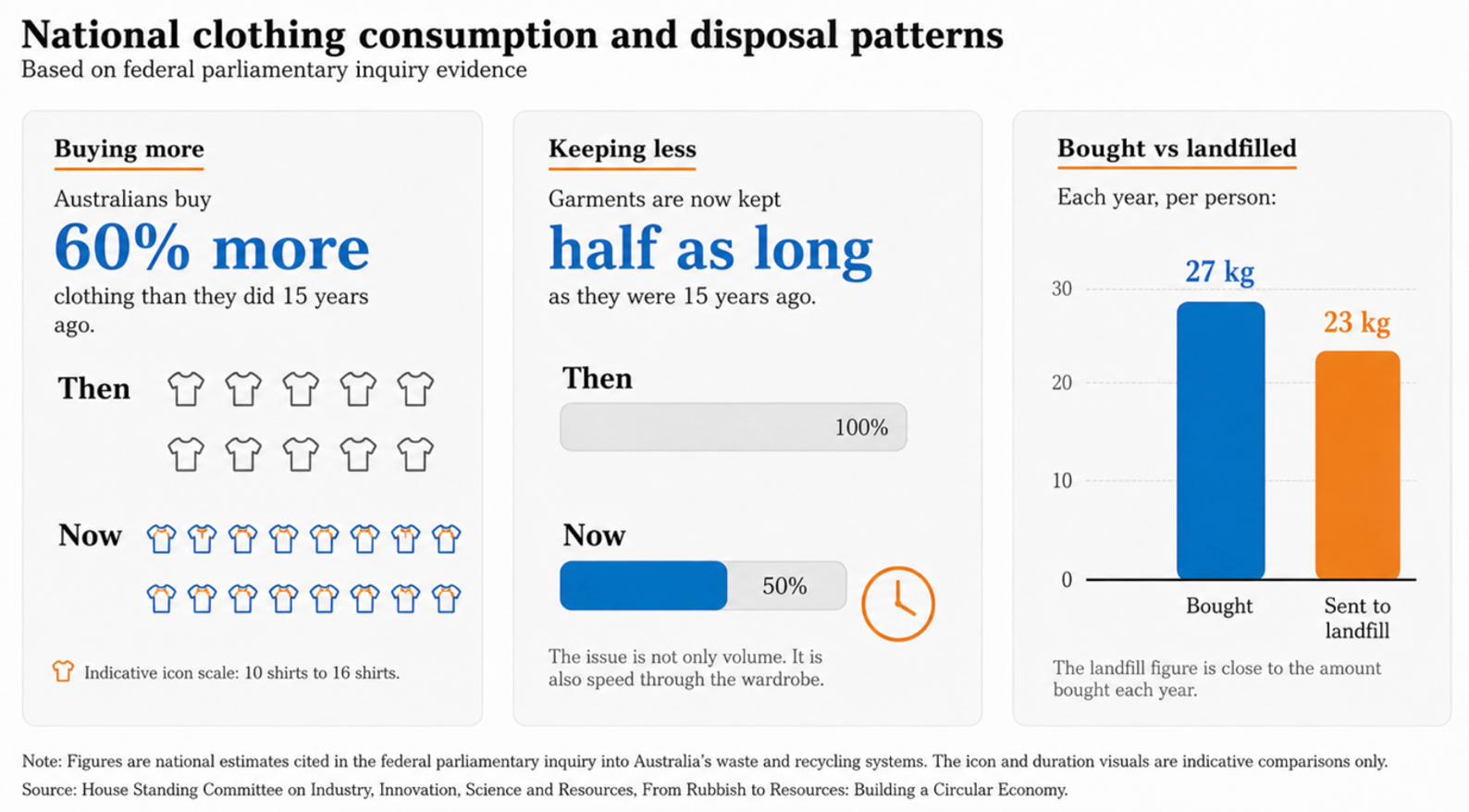
A federal parliamentary inquiry into waste and recycling found Australians now buy 60 per cent more clothing than they did 15 years ago and keep garments for only half as long. On average, each person purchases 27 kilograms of clothing annually and sends 23 kilograms to landfill.
Those discarded garments are part of a much larger textile waste stream. The National Waste and Resource Recovery Report 2024 found Australia generated 860,000 tonnes of textiles, leather and rubber waste in 2022–23, with a recycling rate of just five per cent. Most recovered material in that category was carpet rather than clothing, leaving textiles among the least recovered waste streams in the country.
Much of that unwanted clothing passes first through charity shops. The federal parliamentary inquiry also heard charities are only able to sell around 15 per cent of donated clothing in their own stores. The rest must be redirected through export, ragging, recycling or disposal.
For consumers, donation bins can feel like part of a circular solution. For charities, they often represent additional labour and expense. Donation bags that once brought quality, wearable clothing are increasingly arriving filled with ultra-fast fashion garments that have little resale value. Thin fabrics, blended fibres and poor construction mean many pieces cannot be put on racks, leaving charities to absorb the cost of sorting, storing and removal.
RMIT University sustainability researcher Dr Yassie Samie told ABC News charities had been carrying that burden for years.
“We’re used to charities doing the heavy lifting, but they’ve been unable to fully handle the volume of donated clothes for a long time now,” she said.
When clothing cannot be sold locally, part of the problem moves offshore. ABC News reported that research found wealthy cities like Melbourne were exporting the problem rather than solving it, with around one-third of donated clothing sent offshore instead of reused locally.
Evidence presented to the federal parliamentary inquiry into Australia’s waste and recycling systems also pointed to the limits of recycling. During hearings, textile recycling company BlockTexx told the inquiry blended fabrics, particularly cotton-polyester garments common in fast fashion, were among the hardest materials to recover because fibres must be separated before reuse.
BlockTexx says blended textiles account for more than 60 per cent of global apparel production and remain one of the biggest barriers to large-scale recycling in Australia.
Its Loganholme facility was designed to recycle up to 10,000 tonnes of textiles each year using technology developed with CSIRO and Queensland University of Technology. Against a national clothing waste stream measured in the hundreds of thousands of tonnes, that capacity shows recycling can help, but cannot absorb the scale of the problem on its own.
Mortimer says the rise of ultra-cheap fashion shows why the waste problem cannot be solved by consumer choice alone. He says many shoppers may want to make sustainable choices, but price can override those values when household budgets are tight.
“This is the classic intentions behavioural gap,” he says. “If you talk to people and ask them if they’re an ethical consumer, most will say yes, but then the behaviours are very different.”
He says that gap often comes down to price, particularly when families are already trying to manage rent, mortgages, food and fuel.
“It’s, ‘I really want to buy the $30 T-shirt, but it’s $3 here, and if I save the $27, I might be able to buy something for my kids or buy more food for the family’,” Mortimer says.
That gap is one reason policy is beginning to shift from consumer responsibility to producer responsibility.
Seamless began operating on 1 July 2024 as Australia’s first national clothing stewardship scheme. It is funded by a four-cent levy on every garment placed on the Australian market by participating brands and retailers, with a reduced three-cent rate for garments meeting eco-modulation standards.
Its goal is to create a circular clothing system by 2030, shifting responsibility back onto producers rather than leaving charities and councils to manage end-of-life waste.
But the scale of the problem is far greater than the scheme’s current funding model. The Australia Institute argued that even if every garment contributed to the scheme, it would raise around $60 million annually, far short of the estimated $1.5 billion needed each year to build a genuinely circular textile industry.
For now, much of the burden still falls on charities and local waste systems.
On the Sunshine Coast, Council’s Resource Recovery Strategy has set a goal of zero waste to landfill by 2041 and has supported targeted textile collection events aimed at diverting linen and other household fabrics before they enter general waste.
The Queensland Government has set broader targets to recover 80 per cent of all waste and reach a 65 per cent recycling rate by 2030.
Australia’s clothing waste problem sits inside a wider global fashion system built on higher production and shorter use cycles. The Ellen MacArthur Foundation found global clothing production doubled between 2000 and 2015 while garment use fell by 36 per cent, reflecting a global pattern of more clothing being made, bought and discarded faster.
Sampson says the most immediate way to reduce pressure on the system is extending the life of existing garments.
“Keeping existing products in use is one of the most powerful levers anyone outside the industry can pull,” she says.
“Clothes swaps, borrowing, op shops, Depop. These are not perfect solutions, but they are accessible ones.”
Post a comment